





Votes & elections.
The voting booklet is in the letterbox — that doesn't mean it has been understood. The City of Zurich explains ballots and the Riedhof school proposal, the City of Zug the Theater Casino vote — factual and politically neutral.
A direct line to the public.
Ballot proposal, e-portal, new legislation — and the public is meant to understand it, not just receive it? Good video communication speaks to your audience directly: competent, neutral and in the national languages. We have done this since 2012 for cities, cantons and federal offices across Switzerland.

These public institutions communicate with us:
In public administration the topics are complex — and the audience is the whole population. Whether you call it an explainer film or an explainer video: four explaining jobs from our public-sector projects:
The voting booklet is in the letterbox — that doesn't mean it has been understood. The City of Zurich explains ballots and the Riedhof school proposal, the City of Zug the Theater Casino vote — factual and politically neutral.

The online form exists, and people still queue at the counter. The Canton of Basel-Stadt explains digital building permit applications, the Canton of Bern how to fill in the apprenticeship contract online, the State Secretariat for Economic Affairs the relaunch of the official gazette portal.

Newcomers know neither the office nor the procedure — and need both. The State Secretariat for Migration explains the path to vocational training and diploma recognition.

New rules for your own house, and every department reads them slightly differently. The City of Lucerne introduces data protection by video; the Canton of Zurich presents its health protection unit.
Nine examples from city, canton and federal level — from over 6,500 projects since 2012. 4.82 out of 5 · over 280 reviews on ProvenExpert.





How public institutions set up a video project internally — from planning to process reliability — is covered in our guide "Explainer videos for authorities". For votes and elections, there is a dedicated guide: "Voting videos: democracy explained clearly".
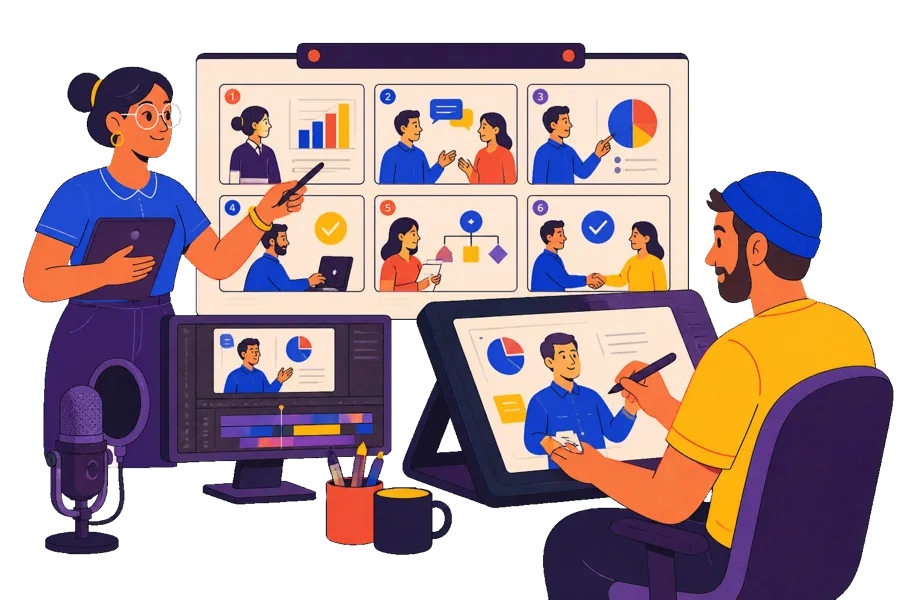
Many stakeholders, clear milestones: we produce in five steps with two feedback rounds per phase and a transparent schedule — every office gets its say without the deadline slipping. See the explainer video production process.
From the ballot paper to the building permit: ballots and the Riedhof school proposal for the City of Zurich, the Theater Casino vote for the City of Zug, the path to vocational training and diploma recognition for the State Secretariat for Migration, the relaunch of the official gazette portal for the State Secretariat for Economic Affairs, digital building permit applications for the Canton of Basel-Stadt. Internally: the introduction to data protection for the City of Lucerne, the health protection unit for the Canton of Zurich. The pattern: wherever extensive topics, services or responsibilities need explaining — to the public or within the organisation — a video replaces pages of official prose with two minutes of clarity.
If your topic sounds more specialised, we find the simplest way to tell it in the kick-off workshop. Having worked for city, canton and federal levels, we know the difference between citizen communication, expert audiences and internal information — and pitch the altitude to match.
Yes — with voting videos, neutrality is craft, not an add-on. Process videos show how voting works — from opening the envelope to sending it back correctly. Issue videos explain a specific proposal: What is being built? What does it cost?
Which options are on the table? They inform without judging. We check wording, imagery and even the order of arguments for balance — and your chancellery or communications team approves script and storyboard before animation starts. That is how we explained proposals for the City of Zurich, the City of Zug and other public bodies without ever taking sides.
The sender stays unambiguous: your corporate design, your tone, official information — clearly distinct from the committees' campaign material. More on this, up to the bilingual election series for the Canton of Bern, in our guide to voting videos.
Yes — for authorities this is usually a duty, not a nice-to-have. German, French and Italian are standard, further languages on request. Language versions are adapted linguistically and culturally, not just translated — like the three-part election series for the Canton of Bern in German and French. One production yields versions for every part of the country: the same visuals, the same approved message, adapted to audio track, timing and idiom.
Plus subtitled versions for channels watched without sound. Budget tip: plan all language versions from the start — your offices approve only once, and the adaptation gets faster and cheaper. You choose the voices per language from demos, so the French version sounds like Romandy and not like a translation bureau. Conditions are on our pricing page.
From the start, not as an afterthought. For government videos that means: subtitles for people with hearing impairments, clear and calm imagery with sufficient contrast, plain language instead of officialese — and, where requested, sign language, as in our voting videos. Everyone gains: subtitles also help commuters without headphones, plain language also helps people with German as a second language. That is the core mandate of public communication — reaching everyone.
Which measures your video needs depends on channel and audience; we advise you in the kick-off. For the budget: accessibility added afterwards costs more than accessibility planned in — subtitles, contrast and speaking pace fit into the concept almost in passing. Which is why we ask about it ourselves. Our article on accessibility in explainer videos gives an overview.
It is built for it. Specialist office, communications, legal, sometimes political bodies — in public administration, decision paths are longer than at an SME. So in the kick-off we define who weighs in and who signs off, and build a transparent schedule that involves every department concerned. In every phase — concept, design, and animation with sound — you have two feedback rounds: your office bundles the responses per round, we consolidate and document the versions.
Smooth even with executive-level sign-off. As an extension of your workbench we keep your back free: you steer the content, we deliver on schedule — four to six weeks as standard; you receive the schedule with all milestones in the kick-off. If one more body needs a say than planned, we absorb it in the schedule — communicated transparently instead of silently postponed.
The same transparent conditions apply to the public sector as to everyone: fixed-price packages by style for 90 seconds, everything included — from concept and script to animation and voiceover. That keeps procurement simple: the price is fixed before the project starts and can be budgeted; the PDF quote with package, services and dates can go straight into your internal processes.
All prices are on our explainer video pricing page — the quote arrives within 24 hours.
With what the video replaces — used correctly, an explainer video is not a marketing expense but public-service efficiency. Four arguments you can substantiate internally.
Add budgetability: the fixed price is set before the project starts, and the PDF quote with services and dates can be disclosed transparently to the finance committee and the public. Calculated that way, it is not the video that needs justifying — it is answering the same question a thousand times by hand.
Yes — accessibility can be retrofitted, even for videos already in use. Fastest are subtitles: from CHF 480 per language version, on request as a separate SRT file, switchable on your website, on YouTube and in learning platforms. Further language versions can be retrofitted too — as subtitles or as a studio voiceover with an adapted audio track — and for voting videos, sign language on request. Our archive makes this possible: the open project files of your video stay safely stored at Videodesign, even years after handover — we work directly on your existing video, without re-production.
If the production dates back a while, send us the video and your requirements; we assess what can be done. Honestly: accessibility planned in from the start is cheaper than retrofitted, and contrast or an overly fast speaking pace can only be corrected to a limited degree afterwards. What works and what doesn't, we tell you up front: a reply within 12 hours, a PDF quote with the right measures within 24.
Explainer Videos for Government & Authorities
Two sentences on the proposal, service or audience are enough — we recommend video type, style and language versions, honestly and without obligation. You hear from us within 12 hours; the PDF quote follows within 24.
Your PDF quote arrives within 24 hours – free and without obligation.