
For a successful online marketing strategy, there is no way around YouTube in 2026. With 2.5 billion monthly active users worldwide and 80% of the Swiss population using the platform regularly, YouTube is far more than just a video platform – it is the largest advertising network after Google.
This guide shows you how to place YouTube Ads step by step, which formats really work in 2026 and what you need to look out for so that your campaign doesn’t end up empty.
What are YouTube Ads?
YouTube Ads are advertisements that are displayed in or next to YouTube videos. You only pay when someone actively views your ad, not simply for reach. This makes YouTube Ads particularly attractive for companies with a manageable budget.

What do YouTube Ads cost in Switzerland?
As a guide: CHF 0.01-0.05 per view for TrueView ads, CHF 0.50-2.00 per click depending on the industry and competition. Bumper Ads and Shorts Ads are cheaper. A daily budget of CHF 10-20 is sufficient for initial tests.
Are YouTube Ads worthwhile for Swiss companies?
Short answer: Yes – if you know who you want to talk to.
According to Statista, around 80% of the population in Switzerland use YouTube, 1.5 million of them every day. According to the IGEM Digimonitor 2025, YouTube remains the most-used video streaming platform in Switzerland, ahead of Netflix, TikTok and Instagram. The platform is particularly strong among the 25-44 target group, i.e. precisely where many B2B and B2C purchasing decisions are made.
The advantages over traditional advertising:
Reach with relevance. You don’t just reach everyone, but exactly the people who are interested in your topic. By age, interests, search behavior or geographical location (e.g. German-speaking Switzerland only).
You only pay for real attention. With most formats, you are only charged if someone watches or actively clicks for at least 30 seconds. Scattering losses are therefore significantly lower than with TV or display.
Full cost control. You set the daily budget and maximum bid yourself. No hidden costs, no minimum term.
Measurable results. Views, clicks, conversions, view-through rate. Everything can be viewed and optimized in real time.
The disadvantages - honestly assessed
YouTube Ads are not a sure-fire success. What often goes wrong:
Target group defined too broadly. Anyone who wants to appeal to “everyone in Switzerland” is burning budget. The more specifically you narrow down your target group, the better the result.
Poor video material. The strongest targeting is useless if the video is boring in the first five seconds. YouTube Ads need a strong start, now.
Too little patience. A campaign needs at least 2-3 weeks to run and sufficient data before you can optimize it. Anyone who breaks off after three days is drawing the wrong conclusions.
Conversion gap. Lots of clicks but no requests? The problem is usually not with the ads, but with the landing page. The page you link to must match the ad.
YouTube ad formats 2026: which one suits you?
Demand Gen Campaigns
Video Discovery Ads and Video Action Campaigns no longer exist. Since 2024, Google has completely replaced both formats with Demand Gen Campaigns. The central campaign type for visual YouTube advertising today.
A Demand Gen campaign automatically plays on all relevant placements: YouTube In-Stream, Shorts, Feed, Google Discover, Gmail and, since 2026, Google Maps. Google’s AI distributes the budget to the placements that perform best for your target.
What sets Demand Gen apart:
- One campaign type for all placements, no more manual splitting
- Videos and images can be combined in one campaign
- AI-supported optimization for conversions or reach
- Creative tests natively integrated
- Since Google Marketing Live 2026: Create video variants directly with Google’s Gemini AI, without external production
Ideal for: Brand building, retargeting, awareness with measurable results.
Skippable in-stream ads (TrueView)
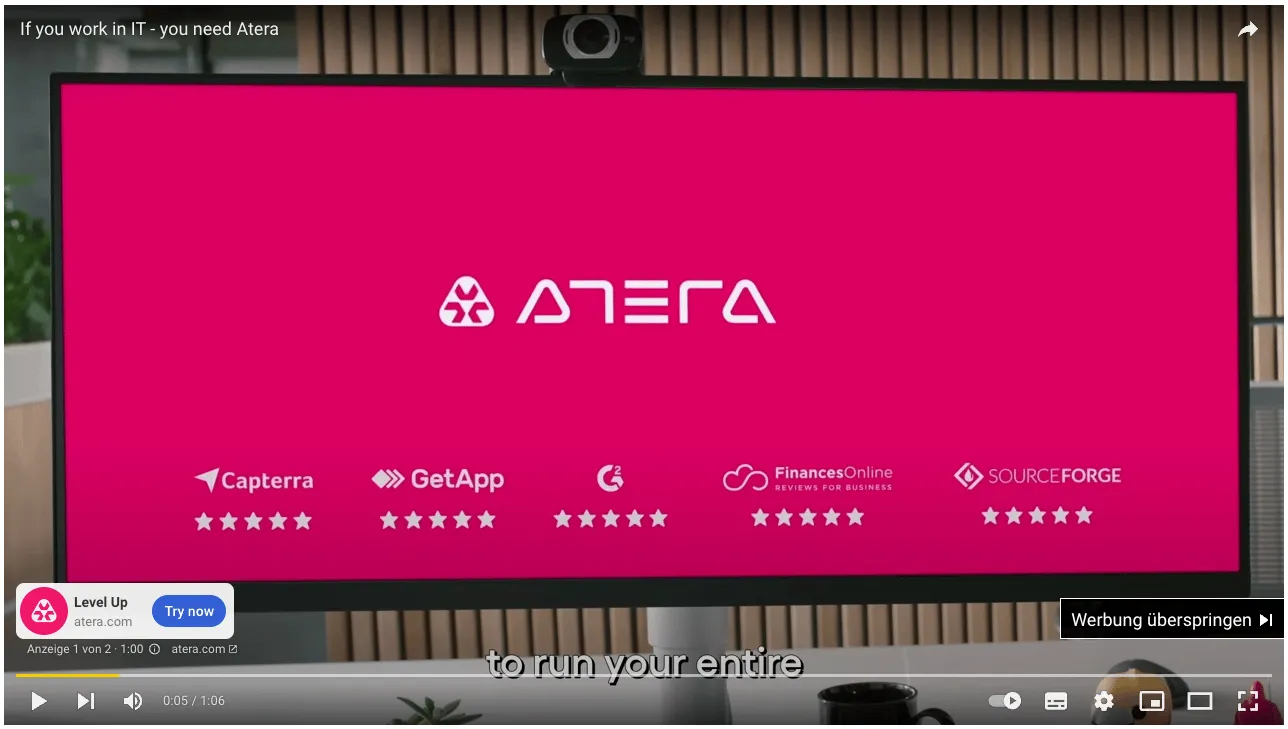
Appears before or during a video. The viewer can skip after 5 seconds. You only pay if someone watches or clicks for 30 seconds. Ideal for explainer videos, product presentations and campaigns with a storytelling approach.
Recommendation: At least 60 seconds long, hook in the first 5 seconds, then you can go into more detail.
Non-skippable in-stream ads
15 seconds, no skip button. The viewer must watch the ad in its entirety. Billed according to views. Well suited for branding campaigns if you are sure that your video will be convincing in 15 seconds.
Bumper Ads
6 seconds, cannot be skipped. Perfect as a supplement to longer campaigns, for example as a reminder after someone has already seen a longer video. Inexpensive and effective for reach.
YouTube Shorts Ads
The format that will grow the most in 2026. Shorts record 70 billion views worldwide every day, with 2 billion logged-in users per month. Your ad is displayed between organic shorts, vertically, maximum 60 seconds, no skip. Particularly effective for younger target groups and impulse-driven products. Important: The video must be produced natively in 9:16 format, no simple cropping of landscape format videos.
YouTube on the television
Over 45% of all YouTube playback time now takes place on connected TVs (i.e. smart TVs, Apple TV, Chromecast and similar devices). This is changing how YouTube advertising works: Audiences are sitting further away, watching more deliberately and skipping less often.
For Swiss companies, this means that YouTube is no longer just a mobile channel. If you have a high-quality explanatory video or image film, you can achieve a reach and attention on TV that classic TV advertising can no longer achieve, at a fraction of the budget.
4 steps to your first YouTube campaign
Step 1: Upload video
Every YouTube ad starts as a normal YouTube video. Upload it to your channel. You can set it to “not listed” so that it is not found organically, but can still be played as an ad.
Step 2: Create campaign in Google Ads
Go to ads.google.com → “New campaign” → Select target:
- Leads: if you want inquiries or registrations
- Website traffic: if you want to send visitors to a specific page
- Brand awareness and reach: if you want to reach as many people as possible
- Without a goal: if you want to optimize yourself
Then select the Demand Gen campaign type and link your YouTube video. The classic “Video” type no longer exists for most use cases; Demand Gen has replaced it.
Step 3: Determine target group and budget
This is where the real leverage lies. Define:
- Geographical: Switzerland only, German-speaking Switzerland only, or specific cantons
- Demographic: age, gender, household income
- Interests: What else does your target group look at?
- Keywords: For which search queries should the ad appear?
- Remarketing: People who have already visited your website, a particularly valuable target group
Budget: Start with CHF 10-20 per day for the first two weeks. Enough to collect data, not too much to lose if you make mistakes.
Step 4: Set up and launch the display
Add CTA button and title, enter target URL, start campaign. Then let it run for at least 7-14 days before you make any changes, the algorithm needs time to learn.
4 tips for YouTube ads that really work
-
the first 5 seconds decide everything. Show immediately what it is about, a concrete problem, a surprising statement or a strong image. Anyone who doesn’t arouse curiosity in the first 5 seconds will be clicked away.
-
show branding early on. Logo or product name should be visible in the first 5 seconds, even for users who skip immediately a visual impression remains.
-
set a clear CTA. What should the viewer do? Enquire now, find out more, secure an offer. Only one CTA per video, not three.
-
think mobile first. 70% of YouTube views come from smartphones. Text must also be legible on small screens, the speaker should be easy to understand, even without subtitles.
-
prepare three formats. Demand Gen campaigns play your video in different placements. If you only have a 16:9 landscape format, you will miss out on short placements and feed placements, where square (1:1) or vertical (9:16) material performs much better. Simple cropping is not enough, the first second must work just as well in vertical format as in landscape format.
Conclusion: YouTube Ads 2026 - is it worth it?
Yes, but only with the right video. The best targeting is useless if the video is not convincing. Anyone investing in YouTube Ads should first make sure that the video material is strong enough.
Do you want an explanatory video or an image film that also works as a YouTube ad? We create videos that don’t just look good – they convert. 6,500+ projects since 2012. Get your free consultation.

Arrange a free consultation with our video experts. Together we simplify your communication.
Photo Credits: StockSnap, Ksv_gracis,, Freepik